I felt like my husband's housemate after our second child. Here's how I became irresistible to him again — in 6 weeks.
My name is Adaeze. I'm a mum of two. And this is my story.
You see… my husband Emeka and I? We were that couple. I'm telling you. The ones people talked about at every gathering. We laughed too loud. We finished each other's sentences. His hand was always somewhere on me — the small of my back, my shoulder, my knee under the table — like he just needed to keep touching me to be sure I was real.
He used to call me in the middle of his work day. For no reason. Just to hear my voice, he'd say. We'd gist till 2am about absolutely nothing and wake up tired and not even care. And the way that man used to look at me when I walked into a room — like there was nobody else in it. Like I was the only woman in Lagos.
Hold onto that picture. Because here's where it starts to hurt.
Then Chukwuemeka came in 2017. Then Adaora in 2023. And somewhere between the night feeds and the school runs, the cooking and the endless managing — that couple quietly packed their bags and left.
We didn't fight. That's the part that confuses people. There was no betrayal, no shouting, nothing to point at. We just slowly turned into two efficient strangers running a household together. Co-parents sharing a bed, a budget, and a surname.
And then one day I realised I could not remember the last time my husband had looked at me — really looked — instead of looking past me to ask if the baby's bag was ready.
When did he last have time for me? Just me? Not the mother of his children. Not the woman who runs his house. Me.
I didn't have an answer. And that's when the other things started.
I began avoiding mirrors. I'd dress with the lights low. At owambe I'd watch a man rest his hand on his wife's back as they walked in, and I'd have to look away — because the wanting in my chest actually embarrassed me. Imagine that. I was being touched all day by children, and not once, in months, by my own husband.
But the thing that truly kept me awake? The thought I could never, ever say out loud?
It would come in the dark, after he'd fallen asleep. Soft at first. Then louder.
A man who stops being wanted at home… how long before he finds somewhere else to feel wanted?
I want to be clear — Emeka gave me no reason. None. He was a good man. But every wife reading this knows the fear I'm talking about, because every wife has buried it at some point. It's not really a fear about him. It's a fear about you. About what happens to your home, your children, your whole life, the day a man decides the woman beside him has stopped showing up — and someone else is happy to.
I never said it. Not to my sister. Not to my best friend. I just lay there holding it, night after night.
And then came one Sunday in November that brought every single one of those fears to a head.
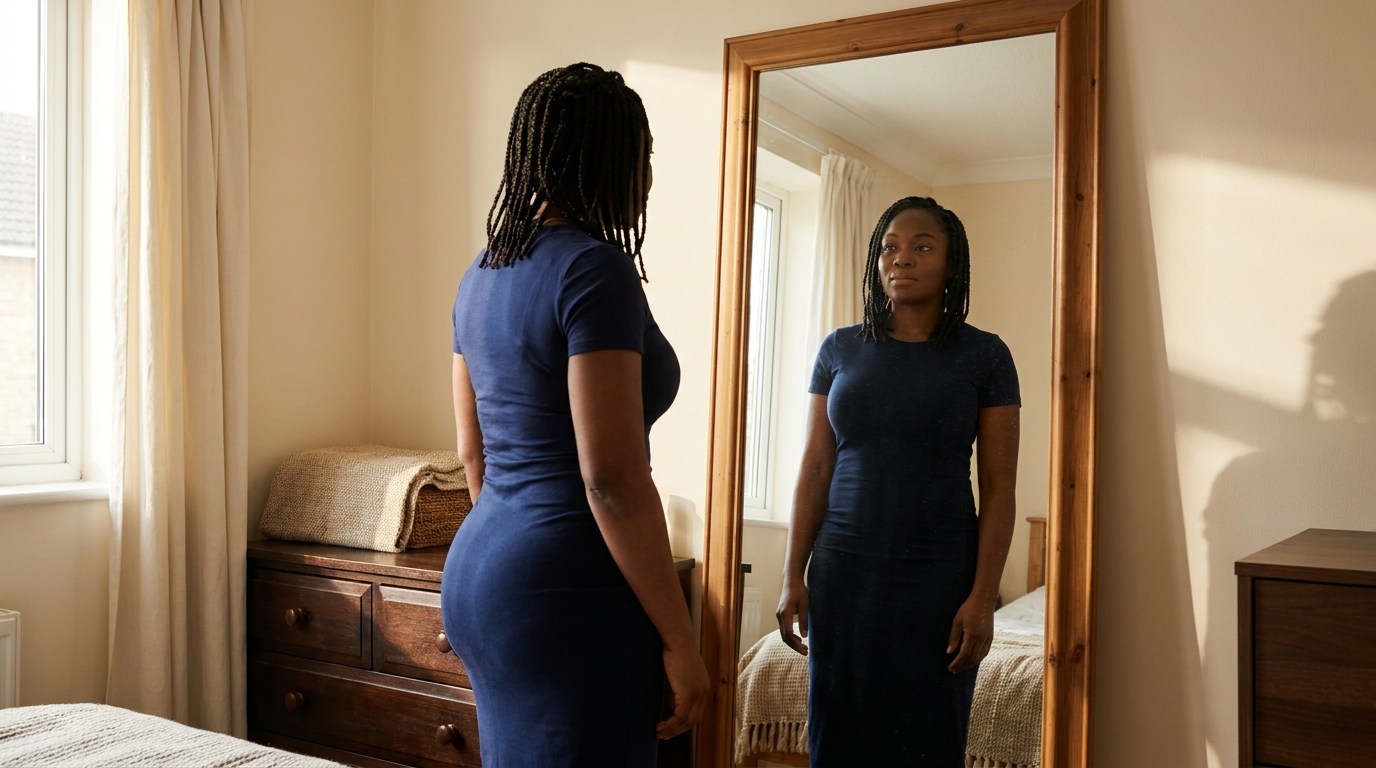
It was three months after my second baby. I put on the blue dress — you know the one, the one your husband used to call "that dress." I did my makeup slowly. Sprayed the perfume I save for owambe. Stood at the mirror and for maybe ninety seconds I felt like a woman again, instead of a milk machine with a to-do list.
Then I walked into the sitting room.
And he didn't look up. Not once. Strapping our son's sandals, he said four words without lifting his head: "Is baby's bag ready?"
That was the whole morning.
I know how small it sounds. But by that Sunday, those four words weren't four words. They were the answer to every question I'd been too scared to ask. And the answer was breaking my heart in the slowest way possible.
By noon, the blue dress was back on its hanger. And I had quietly stopped expecting to be seen.
That should have been the end of my story. It very nearly was.
And then — a Saturday in March, and a naming ceremony I almost didn't attend.
The Naming Ceremony That Changed Things
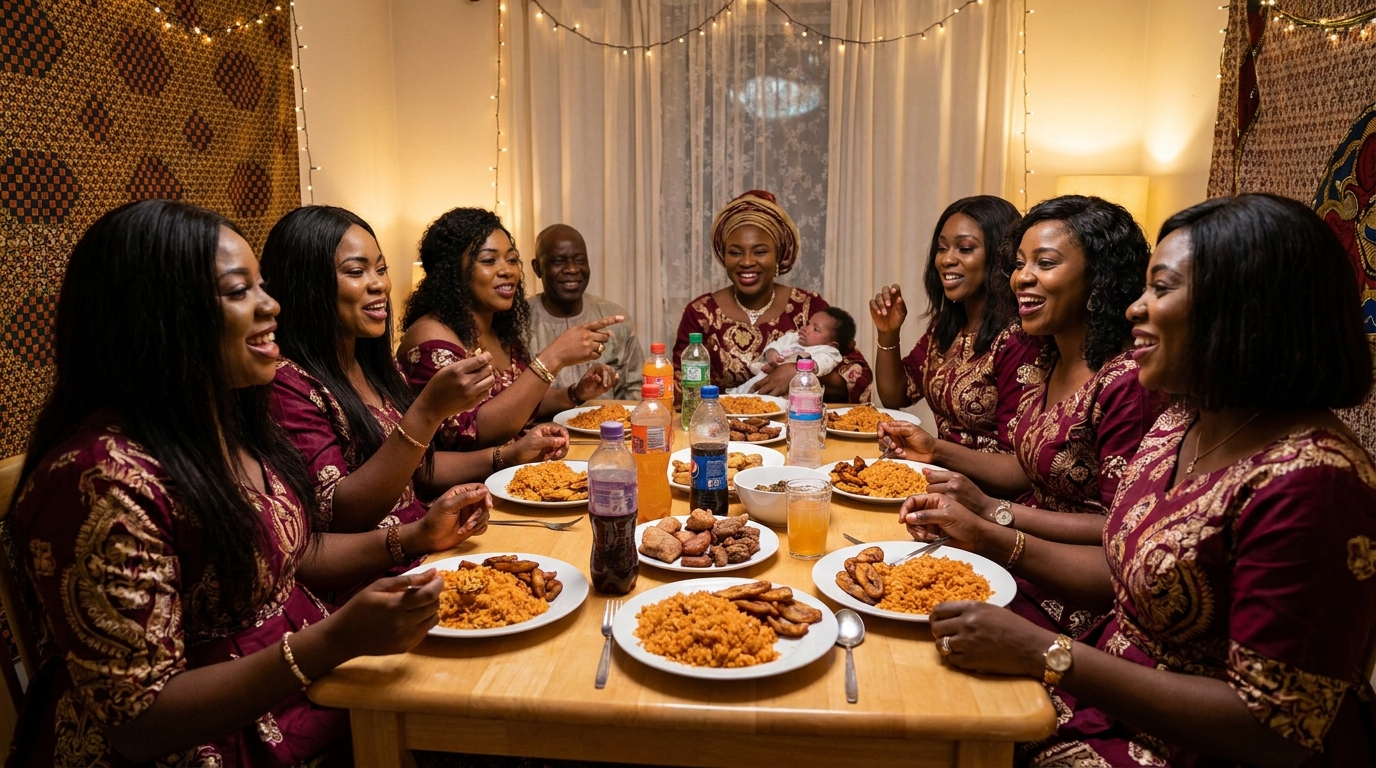
I only went because it would've been rude not to. You know that kind of tired where sleep fixes nothing? That was me. I almost turned the car around twice.
Thank God I didn't. Because of who I sat next to.
Her name was Bola. Maybe fifty. Sixteen years married, she told me later. And ah — there was just something about her. Not fine-girl beauty. Something steadier. A woman completely at home inside herself. And across the room? Her husband kept finding her with his eyes. Sixteen years, two of them in that hall, and he was still looking at her the way Emeka used to look at me.
I noticed it the way you notice the one thing missing from your own life.
We started gisting over jollof. Ordinary talk — until she asked how marriage was treating me. And I don't know if it was the tiredness, or her face, or the small palm wine. But I told her the truth. All of it. The Sunday. The invisibility. The loneliness of lying next to a good man who had stopped seeing me.
She didn't say "it's normal." She didn't say "try date night." She just went quiet. Then she said something I still haven't forgotten:
"There's a small guide a friend forced me to read once. It explained the exact thing that was happening in my marriage — the thing I'd been living inside for years and could never name. By the time I finished it, I knew what had gone wrong. And I knew exactly how to fix it."
— Mama Bola, Lagos (married 16 years)So I asked her — what was it? What did it explain?
She just smiled. And she said: "There's one sentence in it that changed everything for me. But I won't tell you. You won't believe it until you read it yourself."
Abeg. Now I had to know.
She sent me the link that same night. The guide was called How To Become Irresistible to Your Husband Again After Children, written by a Nigerian woman named Comfort George. Children asleep, house finally silent, I climbed onto my kitchen stool and started reading at 10pm. I finished at 1:30am — not because I was forcing myself to stay awake, but because I genuinely could not put my phone down.
What This Guide Told Me That Nobody Else Ever Had
Let me tell you about that first chapter — because I read it three times before I could even move.
It answered the one question I'd been carrying for two years without knowing it even had an answer: why did the spark die?
I'd been telling myself it was just life. That this is simply what happens after children. That every good marriage eventually goes quiet, and that's just how it goes. I'd made peace with it the way you make peace with bad light in a room — you stop noticing how dark it's become.
But what Comfort George wrote was far more specific than "it's just life." And reading it was like somebody finally handing me a torch in that dark room I'd been bumping around in for years.
Follow me here, because this is the part that lifted two years of guilt clean off my chest.
When you carry a baby, your body doesn't just grow a child. It reorganises itself — completely. Your hormones shift. And if you breastfed like I did, your own body was literally producing the chemicals that lower your desire for closeness. Not because something is broken in you. Because biology was protecting the baby. It is normal. It happened to me. It happened to you. It has happened to every mother who ever lived.
But nobody tells you that, do they? So you carry it in silence, wondering what's wrong with you. I did. For two whole years.
And that was only half of it. Because while my body was going through all that — so was my identity.
Think about who you were before the baby. Just you. A woman with her own rhythm, her own wants, her own life. Then the child comes, and a new name lands on you like a uniform you can never take off: Mummy. Full time. No weekends. No leave days. And not one single person stopping to ask, "but how are you doing?"
Now here's the part I had never once stopped to consider. You ready?
My husband was going through his own version of all of it.
Emeka felt pushed out. Not dramatically — quietly. He stopped reaching for me because he'd decided I was too tired. And I stopped reaching for him because I'd decided he had stopped wanting me. You see what we were doing? Two people being considerate of each other in exactly the wrong direction. Both of us pulling back — when what we needed was to lean in.
And day by day, brick by invisible brick, the wall between us got thicker.
That's the cruellest part of all. Nobody built that wall on purpose. Nobody cheated. Nobody caused it. It just grows — quietly — in the space that two tired, careful people leave between them.
I sat in my kitchen and felt something I hadn't felt in two years: it wasn't all my fault. It was never just my fault.
But — and I need you to hear this — none of that was even the sentence Bola had warned me about.
That one was on the very next page. Seven words. And when I read them, I had to turn my phone face-down on the counter just to breathe.
Are you ready for it?
"Being available is not the same as being desirable."
I sat there in the dark and felt the whole floor move. Emeka could always find me. I was always there — cooking, managing, running the entire house. I had made myself completely available… and somewhere inside all that availability, I had stopped being someone he looked forward to. And those two things? They are not the same. They were never the same. Nine years, and not one person had ever shown me the difference.
That was the night it finally landed. I hadn't lost my husband. I'd lost myself — and dragged the whole marriage down with me.
And the moment I understood that, I understood something bigger: if I was the one who got lost… then I was also the one who could be found again.
The only question left was how. And that's exactly where the 30-day plan came in.
What Changed in the First 6 Weeks
1
I started with myself
The guide said: before you touch the marriage, you fix the woman in the mirror first. Day 1, it gave me one small instruction. I'll be honest, I almost laughed — it took two minutes and cost me nothing. But I did it. And by Day 3 I was wearing the blue dress again — not for church, just for me, on a random Tuesday afternoon. For the first time in two years, I felt like a person. I hadn't even spoken to my husband yet. Something in me had already moved.
2
He started to notice
The guide gave me one instruction about how to welcome him home. Just one. Thirty seconds of something I used to do when we were dating and had completely stopped. That evening, when Emeka walked in — I did it. He stopped in the doorway and looked at me like he was trying to place a face he hadn't seen in a long time. Then he smiled. Then he held the hug longer than he had in months. A few days later, I reached out to him in the middle of his day — the guide told me exactly how. Twenty minutes later my phone rang. Not a text. He called. Just to talk. For the first time in I don't know how long.
3–4
The conversation I'd been terrified of
Every time I'd imagined the big talk, it ended in a fight — or worse, in him confirming the thing I feared most. The guide had an entire section on how to have this exact conversation without it blowing up. The timing. The framing. The precise words to open it so it lands as an invitation, not an accusation. I used it exactly. I told Emeka I'd been missing him. He went quiet for a long time. Then he said: "I thought you didn't need that from me anymore. After the children, you seemed fine. Like you had it all handled." All those nights I lay awake fearing he'd stopped wanting me — and he'd been lying on his side of that same bed thinking the exact same thing about me.
6
He cooked for me
I came home from school pickup and the house help was gone. Emeka had sent her out. And there was my husband — in the kitchen — cooking. It was fried rice. And honestly? It was not good fried rice. He'd clearly guessed at every measurement. But that man stood there and made it himself, because he wanted to do something that would make me feel seen. I ate every single grain. I said nothing about the rice. The stranger who'd been living in my home was gone. My husband was back. And so — finally — was I.
Women Are Talking. Read Their Chats.
← Swipe or tap arrows to read more →